Somewhere in 2012 I discovered this website called Reddit. This turned out to be very unfortunate for my attention span. And also my wallet…
I have always been a terminally online nerd and not entirely unfamiliar with sailing the high seas of internet piracy. By late 2014, I had several external hard drive enclosures which were becoming extremely annoying to manage. Earlier that year, I had become self-employed and discovered the /r/homelab subreddit. Awed by all these home setups with various kinds of servers, switches, routers… and finally some disposable income to spare, I was convinced I needed to go this route as well.
NAS v1.0
I bought a Fractal Design Node 304 case, 4 WD Green 4TB drives and an ASRock C2750D4I motherboard and built my first NAS. I installed FreeNAS (which would become TrueNAS later). It lived in the media cabinet of our first house and ran Plex Media Server as a pre-configured jail.
Those pre-configured jails quickly turned out to be very annoying as they were constantly
out of date. Setting up manual jails in FreeBSD and installing the packages with pkg was
somewhat better, but still annoying. Having to ssh into FreeBSD, then iocage console
into a jail, find the previous
pkg update && pkg upgrade <service> && systemsomething restart <service> command was…
cumbersome. But I stuck with it for about 9 more years…
Networking wise, this house was pretty straight forward: it didn’t have any Ethernet cabling in the walls and I only had the NAS and my main gaming PC that I wanted hard-wired, so the 4 ports on our ISP’s router were plenty. The house was also tiny, so the Wi-Fi was “good enough”. I ran a single 10 meter UTP cable along the stairs, under the door, to my office and called it quits there.
NAS v2.0 - Homelab v1.0
Start of 2017 we moved to our current house. I knew I’d want to hard-wire more devices and Wi-Fi would also be more problematic, so we had the builders put in Ethernet in the living room and upstairs in every room. I bought into the Ubiquiti hype and with the fantasy of building my own rack at some point, bought a US 24 PoE 250W.
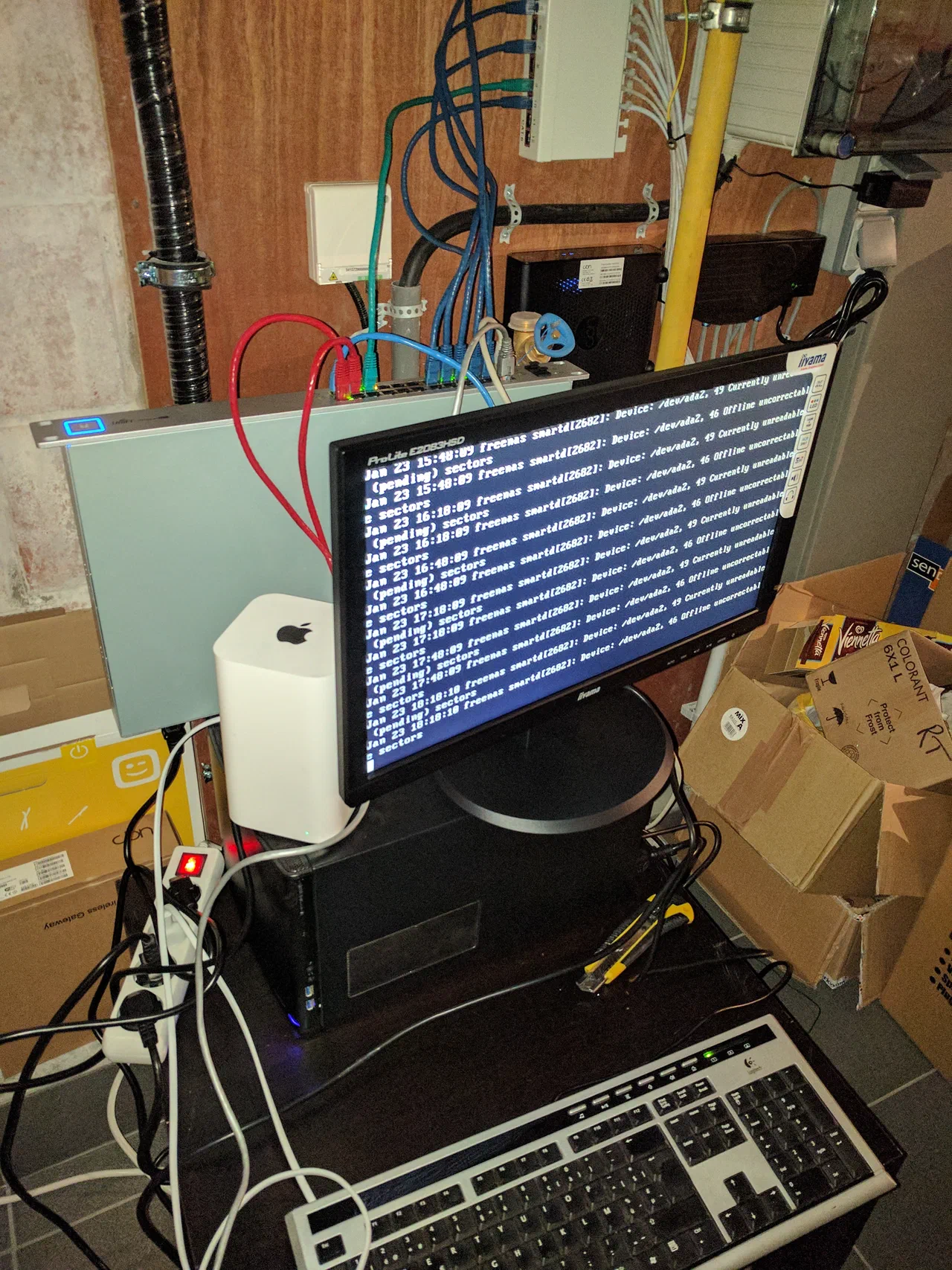
In April 2017, the motherboard died. Apparently a known bug with the C2000 boards. While ASRock honored the warranty, I figured this was a great time to upgrade and build out a rack. Because of somewhat limited space in the garage, I ended up with a wall-mounted, 600mm deep, rack. Finding short-depth server cases was a bit of chore, but I’m still very proud of how this ended up looking.
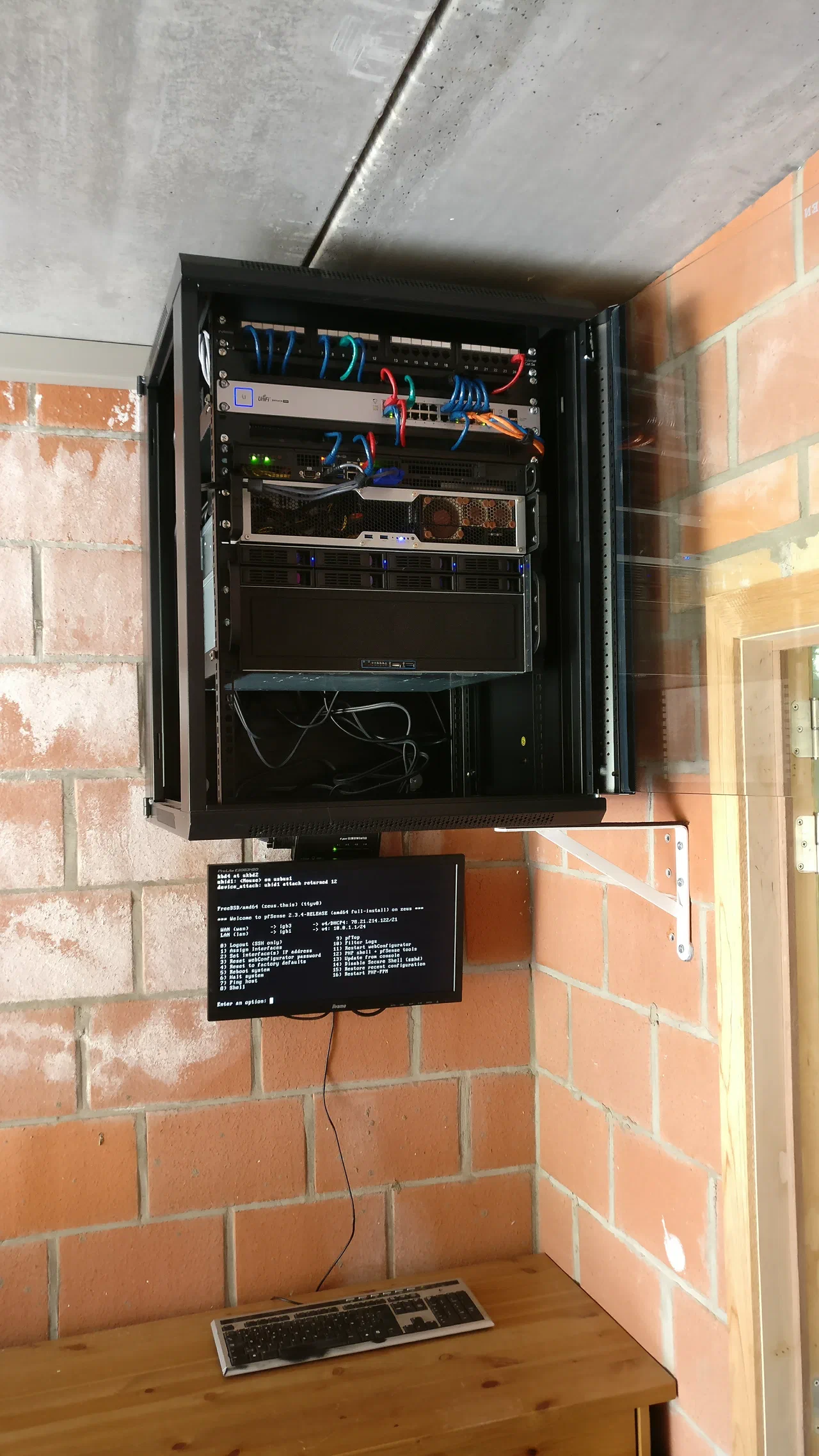
I ended up with:
- Patch panel
- Ubiquiti Switch
- A custom built pfSense router using Supermicro hardware
- The ASRock motherboard transplanted in a new case that ran ProxMox for a while
- The NAS in it’s new case with a SuperMicro X11SSH-F motherboard and Intel Xeon E3-1220 v5 cpu.
- Cheapo KVM switch
- VGA Monitor mounted to the wall
By this point, the WD Green drives had also started failing and I replaced them with WD Reds.
The ProxMox server never ran much useful stuff and used way too much electricity, so that was taken out of the rack fairly fast. I still have it sitting in storage. I should figure out where to bring my e-waste…
NAS v2.1
Storage was running low by May 2020 and because I wanted to be a real homelabber, I figured I had to install an HBA in my NAS. The NAS was also struggling with 4k content and I wanted to upgrade to an Intel CPU that had QuickSync support. The most recent CPU my motherboard still supported was the Intel Xeon E3-1275 v6. I added 4 8TB Ironwolf drives in a new vdev as well for a total of 8 drives now in the system.
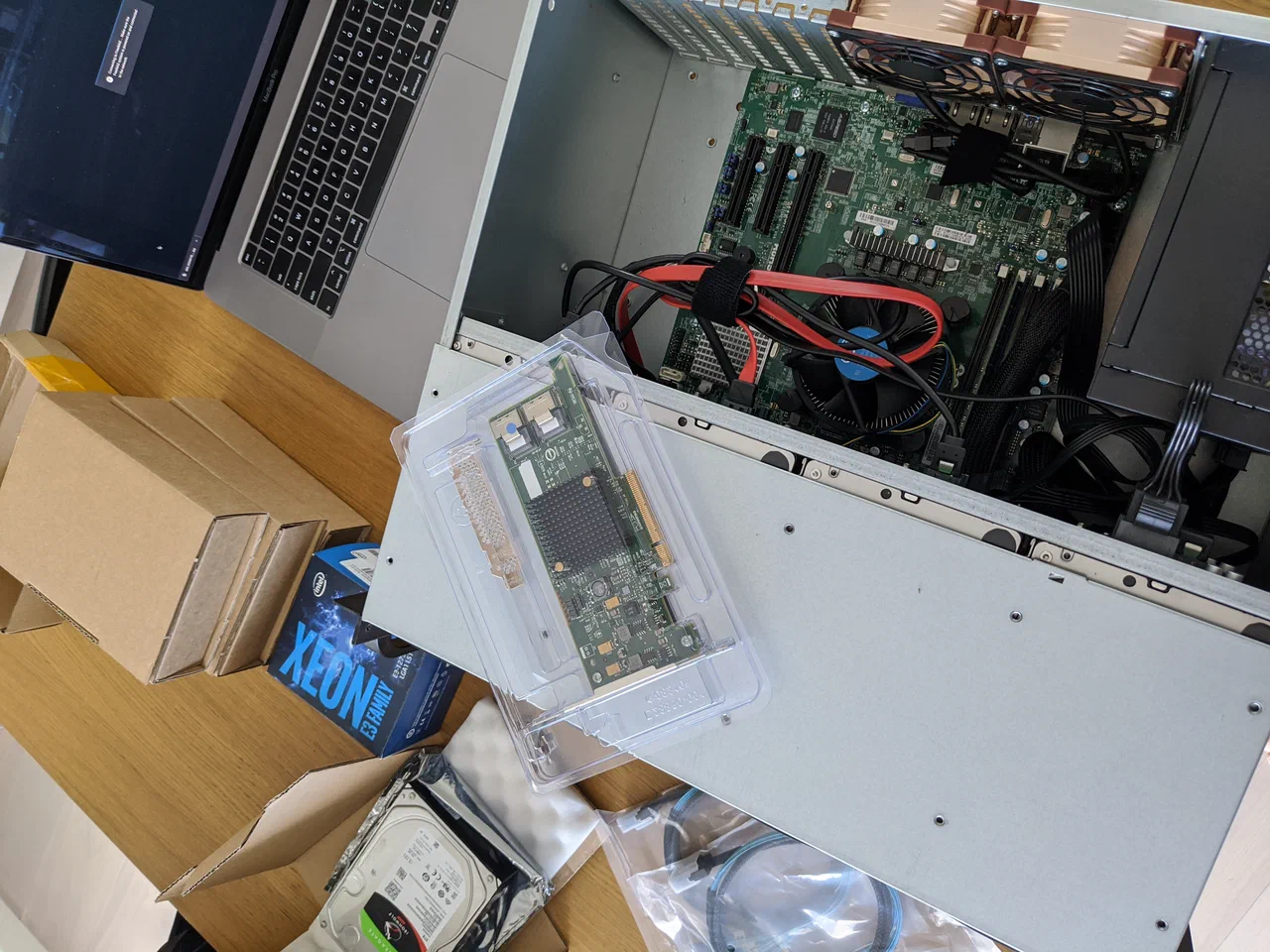
Note: I never got hardware encoding in Plex working in this iteration and 4k video remained an issue.
NAS v3.0 - Homelab v2.0
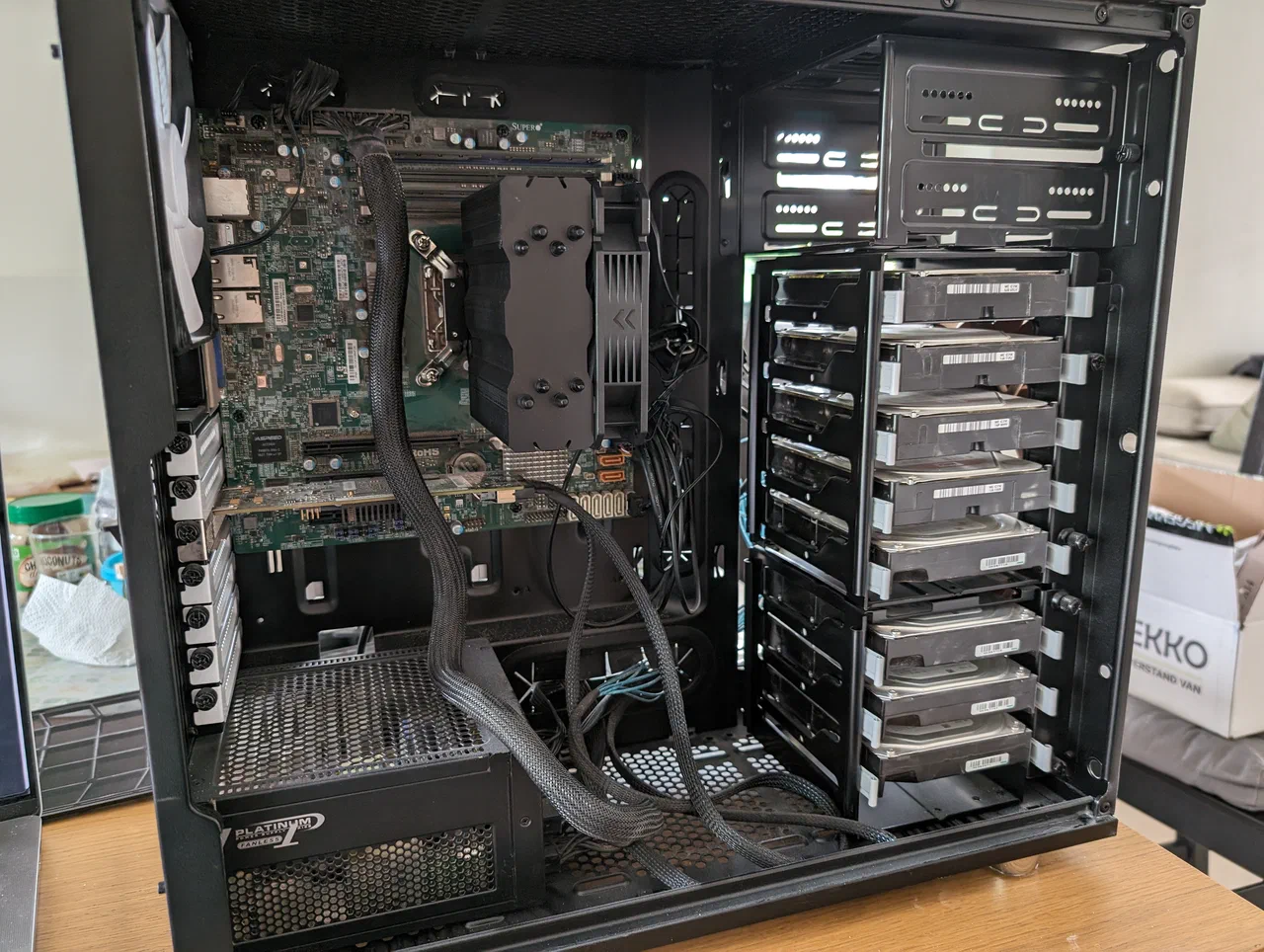
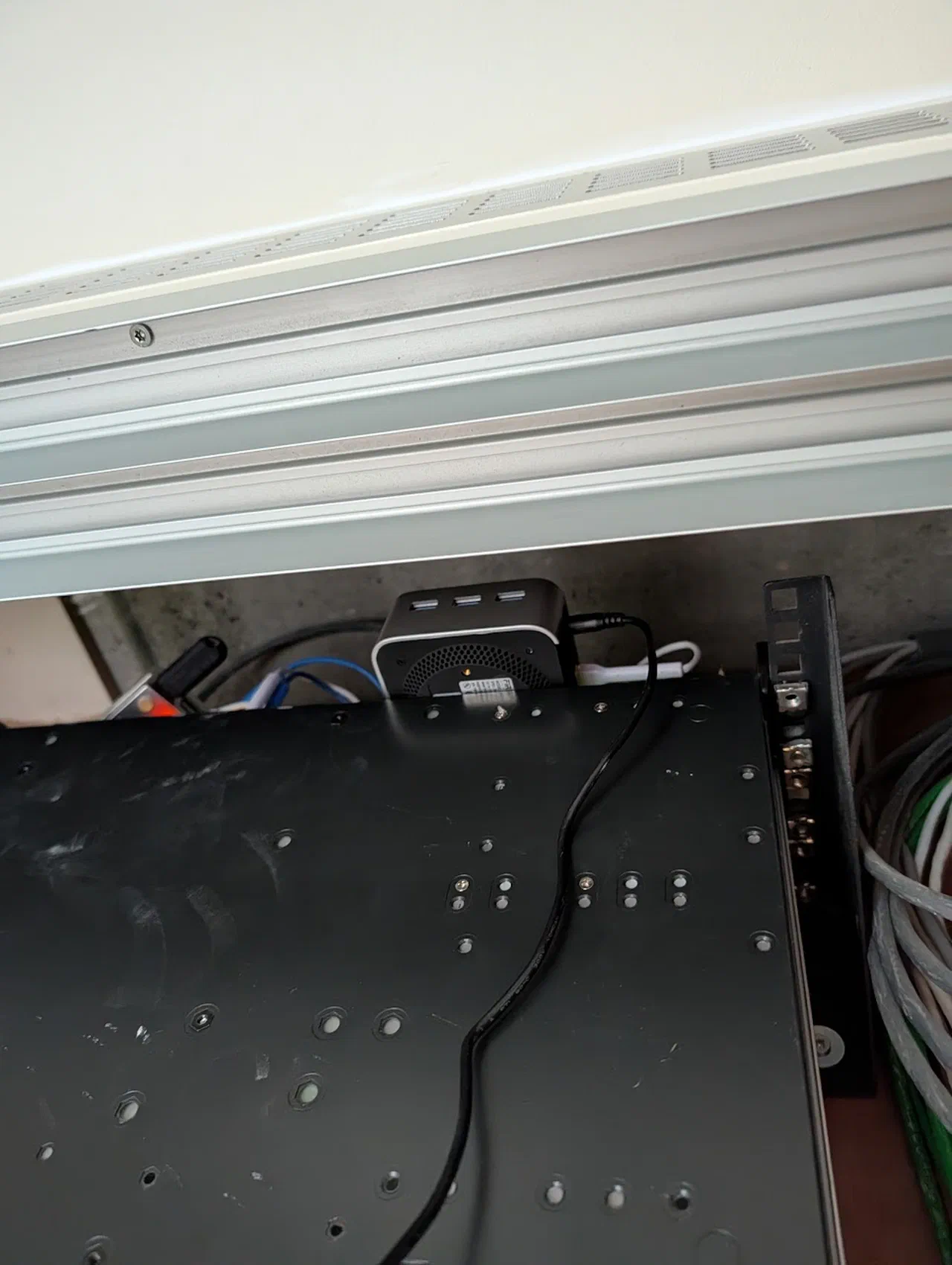
Early 2024 we renovated our garage into a new office for me. This meant the rack had to go and the devices were split out. The pfSense router and Ubiquiti switch stayed in the front near our electricity meter, in a vertical 19" bracket and would be hidden by a cabinet. The NAS was transplanted to a Fractal Design Define R5 and would from now on live under the stairs.
NAS v3.1
In January of 2026, some of the Ironwolf drives started throwing S.M.A.R.T. errors, even though those were younger than the WD Reds (2017 vs 2020). As I was watching more and more 4k content, the NAS had filled up again. I replaced the 8 drives in the system with 6 16TB drives from datablocks.dev, they sell refurbished drives. I took out the HBA again as I considered it a point of failure and power hungry. This lead me on a wild goose chase of more errors and RMA’ing one of the drives, thinking it was faulty, only for it to turn out it was a bad SATA port on the motherboard…
NAS v3.2
June first, 2026, my trusty Seasonic PSU died. It ran for 11 years and 3 months. As it was a P Series, it was only covered by a 7 year warranty (instead of the 12 year warranty they provide on their PRIME series). Their support was incredibly kind and responsive though, so I prompty replaced it with a new Seasonic Fanless PSU, this time from their Prime series.
At this point, the only original part of the v1.0 NAS is the Samsung 850 Pro SATA SSD boot drive that still holds the TrueNAS OS. But that wouldn’t last long…